
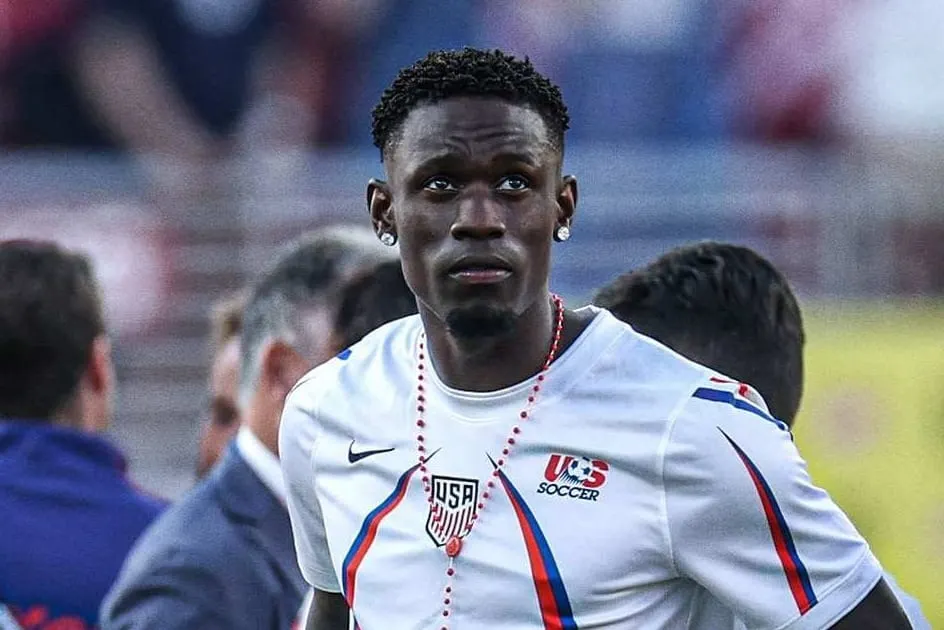
The United States men's national team didn't deserve to have its run to the FIFA World Cup's Round of 16 sullied by a dubious administrative decision, but that's exactly what transpired on the day before Mauricio Pochettino's team plays Belgium for a spot in the quarterfinals.
Folarin Balogun got sent off against Bosnia and Herzegovina in something of a VAR-driven debacle, a decision that was aided by freeze-frames and super slow-motion replays, and over an incident that didn't even warrant a yellow card issued in real time by the match's referee. The red card was widely criticized, but it wasn't unprecedented or particularly out of the ordinary for VAR to make a controversial intervention or recommendation.
Unfair or not, Balogun saw red and would miss the Belgium match, as is standard for a player sent off, or so it seemed. There was much in the immediate made about how a mechanism to appeal a red card like Balogun's didn't exist, but impossible is an opinion, as a former MLS coach once said.
Unprecedented stuff began to happen in the days following that decision and the win over Bosnia, as we now have lots and lots of reporting that indicates that United States government officials, including the president of the United States himself, launched a coordinated pressure campaign to get the powers-that-be at FIFA to rescind Balogun's red-card suspension and free him up to play against Belgium.
Calls and overtures from the US government seemed to work, as word came out on Sunday that FIFA was suspending Balogun's one-match suspension, freeing him up to play against Belgium. According to FIFA, this was a decision reached by its independent disciplinary panel, which cited Article 27 of FIFA's Disciplinary Code.
Article 27 stipulates that FIFA can suspend the implementation of discipline, in this case Balogun serving a one-match ban for his red card, and instead can put the person subject to discipline on probation for up to one-to-four years.
Nothing in that Article 27 specifies under what circumstances FIFA may choose to apply this approach, it's just in writing that they have the power, if they so choose. FIFA's disciplinary committee used this same maneuver in another high-profile recent case, that of Portugal's Cristiano Ronaldo, who was set to be suspended for the first two matches of this World Cup after being sent off during a qualifier against the Republic of Ireland — until his three-match ban got pushed aside, with FIFA citing Article 27 in the process.
Now Balogun is the latest high-profile player to receive this treatment from FIFA, kicking up a worldwide furor in the process. The decision from FIFA's disciplinary committee has been widely, loudly criticized, be it for the appearance of political influence wielded by the United States government, or just because of how unprecedented it is in a World Cup setting. As Opta pointed out on social media, since the introduction of yellow and red cards at the World Cup in 1970, no player to receive a red card has gone on to play in his team's next World Cup match.
This is not the kind of history the United States was trying to make at this summer's World Cup. Beating a European team in a knockout match for the first time, sure, but getting your star striker off a red-card suspension through questionable administrative circumstances is not likely to place high on the list of desired historic World Cup accomplishments.
The issuing of the red card itself was a questionable decision, but what has followed in the lead-up to the Belgium game has drowned out even that legit talking point, and threatens to cloud everything the USMNT has accomplished this summer through the sheer volume of the outrage around Balogun's reprieve.
Belgium's football association and UEFA are dropping lengthy statements condemning FIFA's actions, and even the ethically-questionable former FIFA president, Sepp Blatter, is positioning himself as a Voice of Reason on issues of sporting integrity, a sign that FIFA really and truly messed this up.
All this off-field drama puts the United States team in a terrible position heading into the Round of 16, even if their chances of reaching the quarterfinals are improved with Balogun (tentatively?) available to play against Belgium. This is a massive off-field distraction, the kind of story that has escaped containment and shifted from a purely soccer one into something bordering on an international political crisis.
The involvement of the US government is a big reason why this situation has devolved so rapidly into a distraction and a sideshow. Even while FIFA claims this decision was made independently of any calls or influence from Donald Trump or his appointees, the specter of the US government's involvement sullies the proceedings, especially as Trump himself rushes to take credit for getting Balogun freed to play against Belgium.
You can't ever entirely separate the men's national team from the United States that it represents, but the World Cup, prior to this Balogun kerfuffle, offered a chance for the USMNT to represent the country and do it while free of much of the baggage that surrounds the current version of the United States and this World Cup played predominately on its soil.
By seeing the Trump administration force its way firmly into the middle of this red card situation, it becomes impossible for many people to separate the national team from the national government, and opens the door to plenty of critiques about undue influence wielded by that government over FIFA, a relationship that already raised many an eyebrow dating back to the awarding of that inaugural FIFA Peace Prize, or maybe dating back even further to when FIFA let Trump hand out its Club World Cup trophy last summer.
The World Cup always brings with it a fair share of off-field distractions, but this is one of the biggest ones to ever involve the United States. The players who will face Belgium, Balogun included, will likely dismiss any talk of this situation influencing their prep for Belgium or their performance against the Red Devils, but it's impossible to avoid viewing this match through a completely different lens now that all this off-field drama has unfolded in the hours immediately before kickoff in Seattle.
The USMNT's performances have been so good this summer that it's extra frustrating to see the circus arrive right on the eve of the national team's biggest match of the tournament. Fair or not, this controversy and its aftermath all becomes another hurdle the USMNT will have to clear as they try to reach the late knockout stages of a World Cup for the first time in decades.